
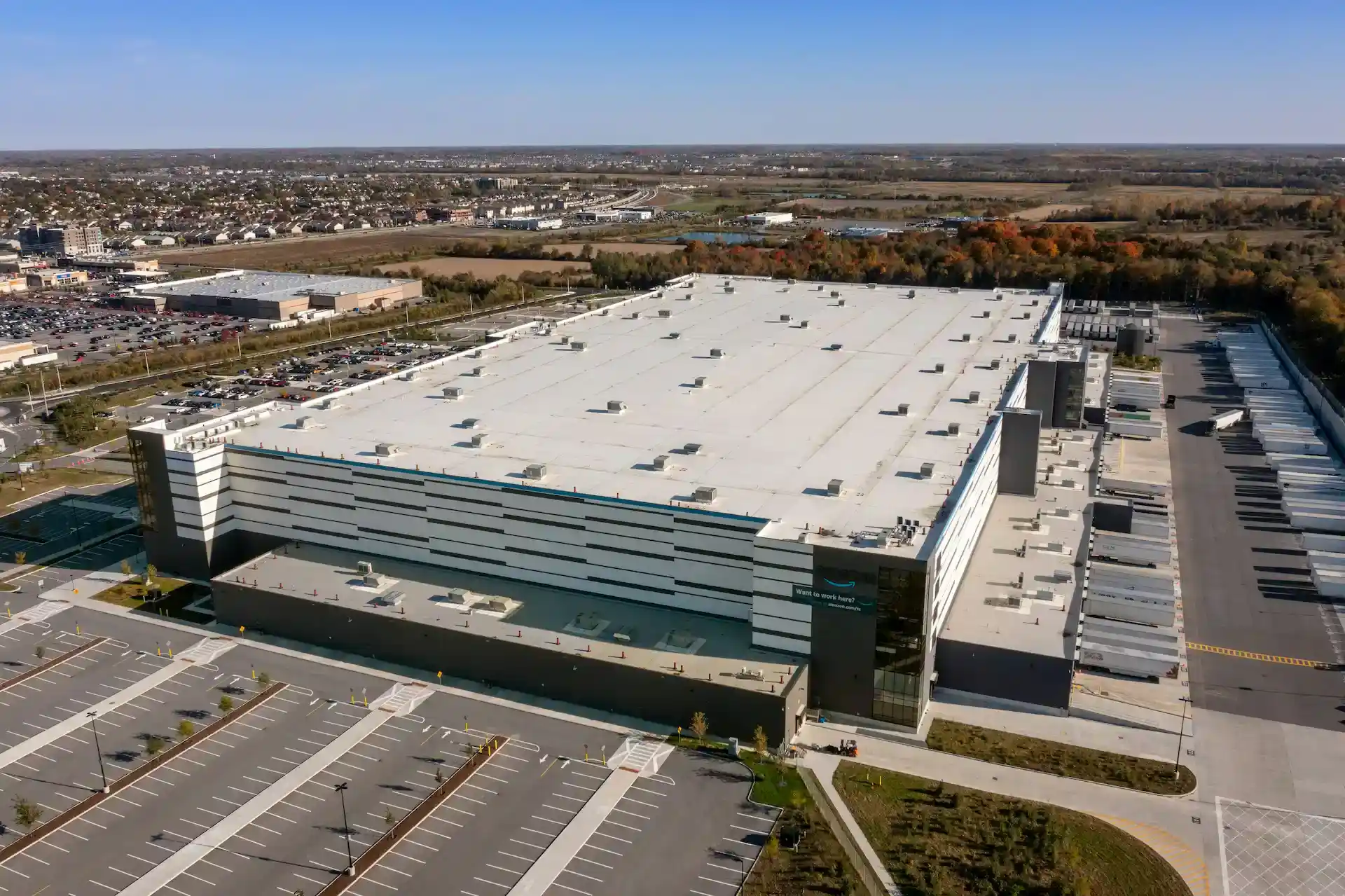
Warehouse and Distribution Center Roofing Planning
United Supermarkets operates a regional distribution center serving its Texas and New Mexico grocery stores out of Lubbock, and this facility represents the type of temperature-controlled warehouse roofing challenge that defines the South Plains market. Lubbock sits on the Texas High Plains at an elevation of roughly 3,200 feet, which creates a climate combination unusual for Texas: hot, dry summers with intense UV radiation, cold winters with genuine snow and ice events, persistent High Plains wind from the southwest that tests membrane attachment constantly, and occasional severe hailstorms that can destroy an unprotected membrane in a single event. Warehouse roofing in Lubbock has to be designed for all of these simultaneously.
Hail is the defining roofing hazard in Lubbock. The Texas Panhandle region sees more large-hail events per square mile than almost anywhere in the country, and Lubbock specifically sits in a high-frequency zone. A standard 60-mil TPO membrane is vulnerable to hail damage from stones larger than about 1.5 inches—and Lubbock regularly sees hailstones in the 2- to 3-inch range. For new warehouse construction or full membrane replacement on Lubbock facilities, specifying a hail-resistant membrane assembly is not optional. Options include 80-mil TPO with a ballasted gravel overburden, thermoplastic membranes with factory-applied granule surfacing, or coated metal standing-seam systems in areas of the roof where the load is tolerable. Insurance underwriters in Texas have begun requiring or incentivizing hail-resistant roof systems through premium credits.
Wind uplift is the second major roofing load in Lubbock. The High Plains southwest wind averages 15–20 mph and gusts substantially higher during spring storm season. Membrane attachment at roof perimeters and corners must be engineered for the local wind speed exposure—ASCE 7 calculations for Lubbock require elevated attachment density in corner and edge zones. Metal edge flashings must be secured to resist the same uplift loads, and parapet cap metal should be mechanically fastened rather than relying solely on sealant. A roofing contractor who specifies Lubbock wind loads using generic national defaults rather than site-specific calculations is not providing an adequate design.
Drainage design on Lubbock warehouse roofs must account for both the high-intensity thunderstorm events that deliver 2–3 inches of rain in an hour during spring and the freeze-thaw cycles that occur in January and February. Primary drains sized for the 100-year storm design event and equipped with heat tape in the drain bowl are the appropriate specification. The flat High Plains topography means Lubbock warehouses typically have extremely low-slope roof designs with minimal fall to drains—even 1/8-inch-per-foot slope differences across a large footprint determine whether water ponds or flows, and a roof that was installed slightly out of level can develop chronic ponding zones that accelerate membrane degradation.
Dock penetrations at Lubbock distribution facilities face the added challenge of UV degradation that is more intense at 3,200-foot elevation than at sea-level markets. Standard EPDM pipe boots degrade faster in Lubbock's UV environment than in more northerly or coastal markets. Silicone-coated EPDM boots or thermoplastic boots with UV-stabilizer packages maintain flexibility and adhesion longer under Lubbock's intense solar radiation. All penetration flashings should be inspected annually, with particular attention to the transition between the boot and the membrane where UV-induced brittleness initiates cracking.
Forklift exhaust management in Lubbock warehouses follows the same principles as other Texas markets, but the dry High Plains climate means that HVAC systems work harder and the exhaust ventilation requirements are proportionally larger. A large grocery distribution center running refrigerated storage in Lubbock's summer heat can have dozens of exhaust stacks and ventilation penetrations across the roof. Each must be flashed correctly, and the overall arrangement must be reviewed to confirm that prevailing southwest winds do not carry exhaust from one stack directly into an adjacent HVAC fresh-air intake.
Energy efficiency in Lubbock warehouse roofing is driven primarily by the extreme summer solar load. Surface temperatures on a black EPDM roof in a Lubbock August can exceed 180°F, creating enormous cooling loads for refrigerated or climate-controlled storage. White TPO reflects the majority of that solar energy and maintains surface temperatures 50–70°F lower than dark membranes under equivalent conditions. Texas does not have a state-level cool roof mandate for commercial buildings, but the energy savings from white TPO at Lubbock's latitude and elevation are substantial enough that the economics are compelling without any incentive program.
Contractor selection in Lubbock's smaller market requires more diligence than in major metros. The contractor community is smaller, and not every firm that competes on warehouse projects has experience with large-scale commercial membrane systems. Priority qualifications include a Texas roofing contractor license, manufacturer certification from Carlisle or Firestone for the proposed membrane, and references from comparable warehouse projects in West Texas. A contractor who primarily does residential steep-slope work and occasionally bids commercial flat roofs is not the right choice for a 200,000-square-foot distribution center.
Cost benchmarks for Lubbock warehouse roofing run somewhat lower than coastal or major metro markets but include a premium for hail-resistant assembly components. Budget $9–$13 per square foot for a standard TPO recover and $13–$18 for a full tear-off and replacement with hail-resistant assembly components. Commercial property insurance in Lubbock markets heavily on hail deductible terms, and warehouse operators should review their policy carefully to understand what hail event size triggers the deductible and whether a hail-resistant roofing assembly qualifies for a premium reduction.
Next Step
Send the building address, roof age if known, leak photos or condition photos, roof access notes, tenant limits, and the decision timeline. We will shape the roof walk around wide roof areas, dock schedules, and forklift traffic below the work with dock schedules, roof access, and operating traffic around the building and return a practical scope tied to what can be verified.